
Lake Stevens Past Resident Sources
The target date determines the first source. Current parcel data gives the key for a backward search. The online deed portal is strongest from the mid-1970s forward, historic field books bridge part of the late twentieth century, and Everett-area or county directories reach farther back with real gaps. A census is a dated household snapshot, not a continuous roll.
| Source | Years covered | Where held | What it shows |
|---|---|---|---|
| Recorded instruments | Mostly July 1976 forward online; earlier microfilm | Snohomish County Auditor | Parties, date, type, land key |
| Historic field books | 1970-1999 | County Assessor archive | Historic parcel-card context |
| Lake Stevens in Everett directories | 1901-20, 1922-23, 1925-33, 1935, 1937 | State Library | Dated directory evidence |
| Snohomish County directories | 1882-87 and listed runs through 2000-05 | State Library | County and rural fallback |
| County census | 1887 | Digital Archives | Named household fields |
| Federal census | 1950 is public | National Archives | Household context at enumeration |
No verified Lake Stevens Sanborn sheet was found. Do not substitute Everett coverage. For early house history, use plats, deeds, directories, newspapers, and parcel material.
Start Lake Stevens House History
Begin with Assessor Property Information or SCOPI. Save the full situs address, parcel identifier, taxpayer label, legal description, and linked sale history. “Situs” is the physical property address. It may differ from the mailing address on a tax account. Neither label alone names past residents.
A parcel number is more stable than a street label, but is not timeless. Snohomish County changed parcel numbering in 2000. A split, combination, plat, condominium filing, or boundary action may also alter the key. Keep current and old numbers, the legal description, and document references together. This prevents the previous residents search from drifting to the wrong lot.
Note: Date every Assessor view and retain each role exactly as the county labels it.
Trace Lake Stevens Owners Backward
The deed chain links recorded ownership transfers. A grantor gives an interest, and a grantee receives it. A chain of title is the sequence of instruments connecting those interests. The legal description identifies the land in recorded terms and can outlast a street address.
- Pull the current parcel and legal description from the Assessor, keeping owner and taxpayer roles distinct.
- Find the newest acquisition instrument in the recorded-document portal. Confirm type, date, parties, and land key.
- Search the seller from that deed as a grantee to find the earlier acquisition. Compare dates and land descriptions.
- Repeat backward. Save ARN, book and page, image status, and copy type.
- At the July 1976 boundary, continue at the Everett public counter and microfilm collection or send a clear request.
- Grantor and grantee
- The party transferring an interest and the party receiving it.
- Chain of title
- A linked sequence of instruments for the same land.
- Legal description
- The land description used in legal records.
- Index and image
- An index points to a record; the image or official copy contains it.
A transfer date is not a move date. Lake Stevens previous residents may include people who never held title.
Lake Stevens Deeds Before 1976
Most Snohomish recorded documents since July 1976 are online. Search categories include Name, Document type, ARN, date, Parcel ID, Book and page, and Legal description. The county has required a free account since March 2, 2026. Plats, surveys, and condominium records use the Legal category.
Older research is an in-person or request task. The Auditor Recording Division is at 3000 Rockefeller Avenue, first floor, Everett, WA 98201. Call 425-388-3483 or email recording@snoco.gov. Public terminals, staff, and mail copy requests cover the fallback chain. County information lists staff research at $8 per hour. Check copy costs when ordering. Unofficial online copies are described as immediate, while certified copies are mailed within five business days.
Insider tip. Carry the last online deed's names, instrument reference, and legal description into the pre-1976 microfilm search.
Lake Stevens Historic Property Books
The Historic Property Information search provides scanned field books for 1970 through 1999. It accepts new parcel number, old parcel number, or box number and supports a wildcard, filtering, viewing, and downloads. It can bridge the modern parcel to older Assessor material when the 2000 number change breaks a direct search.
Check the live historic property interface before searching both parcel numbers.
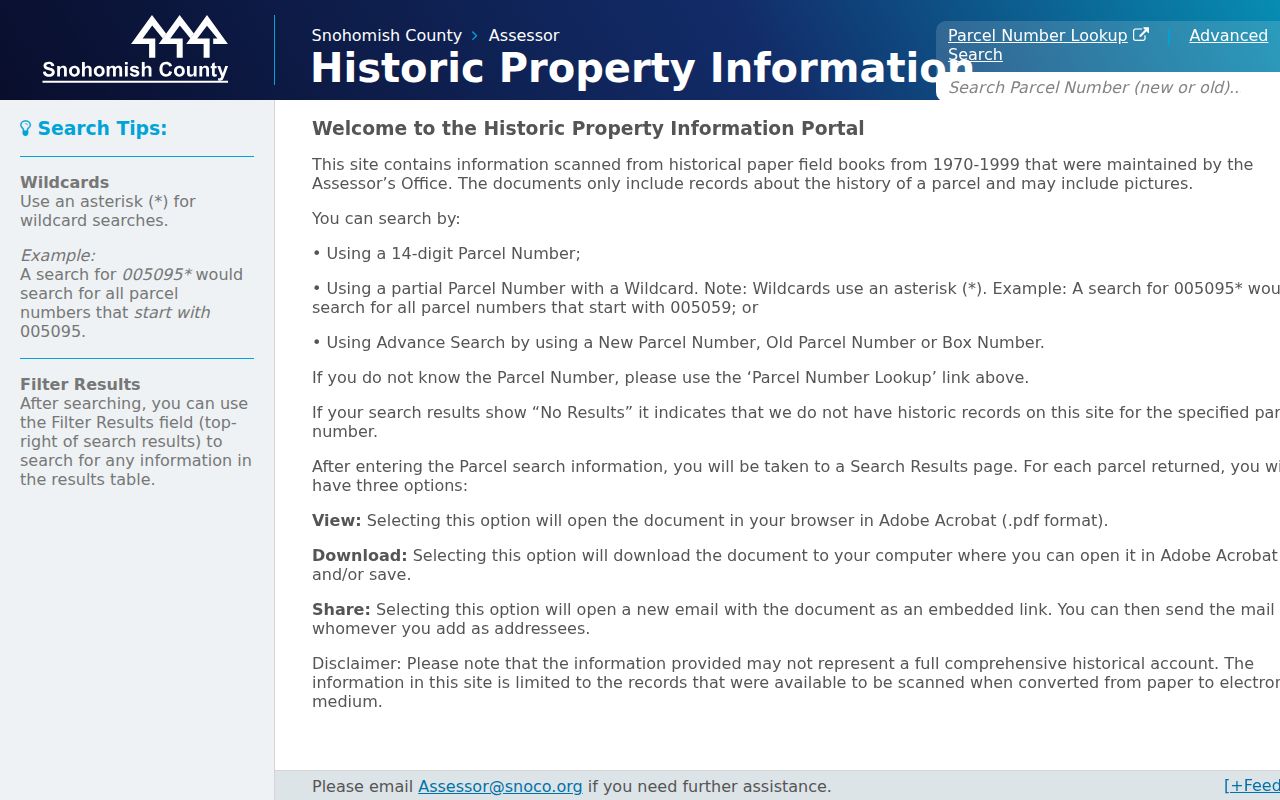
The captured screen shows old-number and new-number routes. A blank result means no scan was found under that key, not that the property never existed.
Save the box, image, page, year, and exact label. A field-book owner or taxpayer is property evidence, not proof of occupancy.
Lake Stevens Land Records Online
The Digital Archives Snohomish land collection adds a second route. Fields include Party Last or Company, First, Middle, Soundex, Party Type, Keywords, Addition Name, and Year From or To, plus Search and Browse. Soundex aids spelling variants. Read the title page for actual coverage and image limits.
Open the collection to review its current fields and notices.
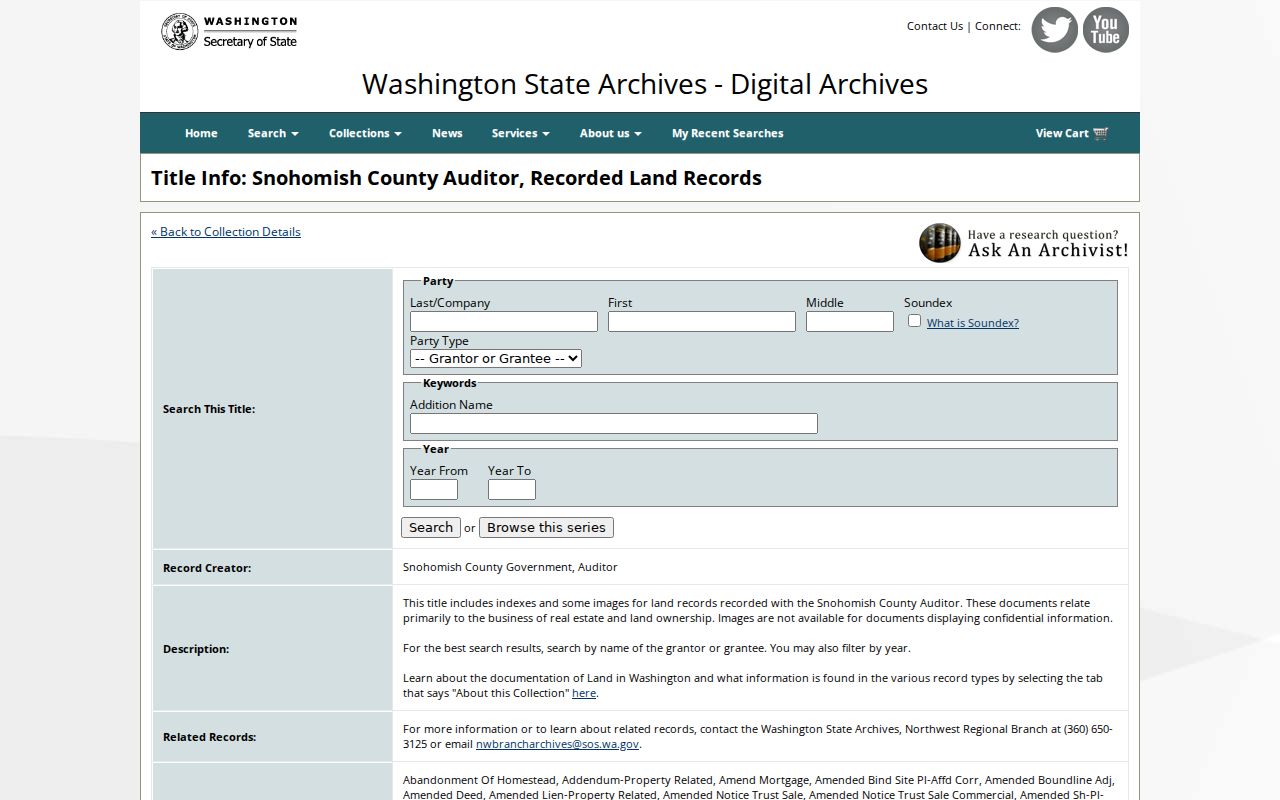
The image shows a party-and-year search, not a full deed chain. Confidential images are unavailable, and each hit must match the parcel or legal description.
The related miscellaneous Auditor collection has a long record-type list. Since the full dropdown was not captured, use the live list. Search may reveal an index entry, but inspect the instrument when wording matters.
Find Lake Stevens Previous Residents
Lake Stevens has a key catalog quirk: the State Library lists it “In Everett directory.” Searching only for a separately titled city volume can miss the shelf. Verified community coverage includes 1901-20, 1922-23, 1925-33, 1935, and 1937. The broader Everett run continues later, and county series offer rural fallbacks. Gaps remain.
The State Library closed to general public access in 2025 and described limited Thursday appointments by email. Check the current directory access page before a visit. The Lake Stevens Sno-Isle branch page does not confirm a local genealogy shelf, so ask staff. Everett-area repositories and the Stilly Valley Genealogical Society catalog are added leads.
Use the closest year, then the county book, Everett heading, initials, spouse, business name, or an old street label. Catalog metadata proves a title and year, not the contents of an unseen page.
Match Lake Stevens Household Snapshots
Owners are just one layer of past residents. A directory may place a name when compiled. A census records a household on enumeration day. A deed records a transaction. Keep those dates separate before deciding they describe the same family.
- Pick the directory year closest to the target and search Everett and county runs with name and road variants.
- Place the result beside the nearest released census, such as the National Archives 1950 Snohomish County search.
- Compare only fields the actual record shows. Never invent an unviewed directory entry.
- Add the deed before and after that date to test ownership, not occupancy.
- Use an obituary, cemetery, newspaper card, naturalization, or probate entry as a dated identity check.
The 1887 Snohomish census holds 3,133 records and supports name, birthplace, year, and Soundex fields. Described entries include household names, age, occupation, marital status, birthplace, literacy, disability, and citizenship. A household may appear under an older county or community label.
Track Lake Stevens Address Changes
Modern Lake Stevens labels do not fit the whole chain. The city incorporated in 1960 and grew by annexation. A directory or deed may use an old community, postal, or county heading. The city's 2013 honorary-street resolution preserves historical names while stating that they do not change the official address.
Log each observed form. Search historic wording in catalogs, newspapers, and the city archive, but retain today's address as the modern reference. Search plats and addition names when a house number fails. A plat can connect an old legal description to current parcel geometry.
Note: Annexation changes jurisdictional context, while a deed, directory, and census each retain an independent date.
Verify Lake Stevens Former Households
A three-record log guards against false matches. First enter the directory or census snapshot with exact name, place, year, and page. Next enter the closest deed with date, type, parties, and land key. Then add an independent source such as an obituary, cemetery, naturalization file, or newspaper notice. Mark conflicts.
| Log field | Preserve |
|---|---|
| Place | Printed address, community label, parcel, legal description |
| Time | Compilation, enumeration, transaction, or filing date |
| Role | Occupant, taxpayer, owner, grantor, grantee, or subject |
| Source | Custodian, URL, collection, page, and search date |
| Confidence | Exact, likely, conflict, or unresolved |
No result can reflect spelling, a missing year, the parcel change, transfer lag, or restricted content. It is not proof that previous residents never lived there.
Use Lake Stevens History Lawfully
Previous residents research supports house history, genealogy, estate work, and family connections. It should not locate or pressure a living person. Washington's Address Confidentiality Program shields actual address details for eligible participants and supplies a substitute address. An older public item may still remain visible, so historic hits deserve care.
Records can be stale or wrong. Names collide. An owner can be a trust, and one parcel can have several interests. Confirm key facts with the custodian, and request an official or certified copy when the instrument matters.
Lawful use. Trace Lake Stevens previous residents for personal history. Never use an address trail to stalk, harass, threaten, or harm anyone.